
Reviewers: Davide Pagnossin, Nicole Moll
EPIC_202526_RU_004v2
DOI: 10.5281/zenodo.19371153
Executive Summary
This research brief summarises patterns of sheep movements to, from, and between the Scottish islands of Shetland, Orkney, and Lewis & Harris over the period 2020-2024. The analysis uses detailed movement data, including slaughter and non-slaughter classifications, to better understand livestock connectivity and identify points of biosecurity risk relevant to sheep scab control. Given that sheep scab remains endemic in Orkney but Shetland is considered scab-free, understanding the direction and timing of movements is critical for guiding targeted surveillance, notification sharing, and risk-based biosecurity messaging across regions. This work builds on previous EPIC research focused on Lewis & Harris and supports policy planning for coordinated Pan-Island sheep scab control, including identifying high-risk periods and movements from key source regions and livestock markets.
a. Quantify the volume and direction of sheep movements involving the
Scottish islands.
b. Identify key source and destination regions for island movements.
c. Assess the relevance of inter-island movements for disease spread.
d. Inform options for coordinated island-wide sheep scab control.
• Shetland has the highest volume of sheep movements overall (aveage ~16,000/year), followed by Orkney (~11,000/year) and Lewis & Harris (~3,700/year) (Table 1).
• Movements involving the islands are dominated by trade with the Scottish mainland, particularly off-island flows from Shetland and Orkney.
• Inter-island movements account for <1% of all flows from 2020 to 2024.
• Outgoing movements from the islands are primarily classified as ‘non-slaughter’, suggesting these involve store or breeding sheep rather than animals sent to abattoirs. This elevates the disease transmission risk, since animals are likely integrated into new flocks.
• Incoming movements to islands are also predominantly classified as ‘non-slaughter’, particularly to Orkney and Shetland. These may represent a key route for introducing disease, including sheep scab.
• Shetland → Orkney is the most prominent inter-island route, with conistent non-slaughter movements (~5,000 sheep/year at peak).
• Reverse flows from Orkney → Shetland are less common but present annually.
• The volume of movements involving Lewis & Harris is low, with fewer inter-island connections, potentially making it easier to prevent sheep scab introduction through isolation and targeted monitoring.
• Key shared markets include Thainstone (ANM), Quoybrae (ANM), Dingwall (D&HM), and Orkney Mart, linking all three island groups with overlapping trading networks.
• Movements from Orkney to both Shetland and Lewis & Harris are relatively infrequent but may be epidemiologically relevant, given that sheep scab is endemic in Orkney and absent in Shetland.
Table 1: Average Annual Sheep Movements (2020-2024)

Key Markets and Source Regions
• Shetland’s high-volume off-island trade principally involves Shetland Mart, Shetland Ferry Terminal, and Quoybrae Mart. Most incoming movements are from Thainstone, Quoybrae, and Orkney Mart.
• Orkney’s movements are mainly via Orkney Mart, with key incoming markets including Quoybrae, Thainstone, and Penrith (Cumbria).
• Movements to and from Lewis & Harris are centred on Stornoway Mart, with imports primarily from Dingwall and Thainstone.
• Top mainland regions supplying sheep to the islands are Caithness, Aberdeen, Cumbria, Inverness, Sutherland, and Ross and Cromarty.
• Orkney receives the highest import volume, followed by Shetland and then Lewis & Harris.
The frequent movements of sheep from mainland Scotland to the islands represent a potential route for introducing sheep scab, particularly because most animals are moved for store or breeding rather than slaughter. Inter-island movements, though limited in volume, include regular trade from Shetland to Orkney and smaller, consistent flows from Orkney to both Shetland and Lewis & Harris. Given that scab is more commonly reported on Orkney, these routes may present a risk of disease spread to scab-free areas. Lewis & Harris receives relatively few sheep imports overall, offering an opportunity to strengthen sheep scab control through continued proactive measures. Take together, these findings are directly relevant to sheep scab control policy. A coordinated, pan- sland approach is supported by the presence of strong trade links, shared markets, and inter-island connections. Policies could focus on targeted surveillance, harmonised notification systems, and seasonal communication, particularly around the late summer- Autumn peak movement period and high-risk source areas on the mainland.
The analysis is based on recorded sheep movements between 2020 and 2024 and reflects only direct, traceable movements to, from, and between the islands. Return journeys were not linked across years, so seasonal patterns such as overwintering movements, where sheep are temporarily relocated and return the following year, are not fully captured yet.
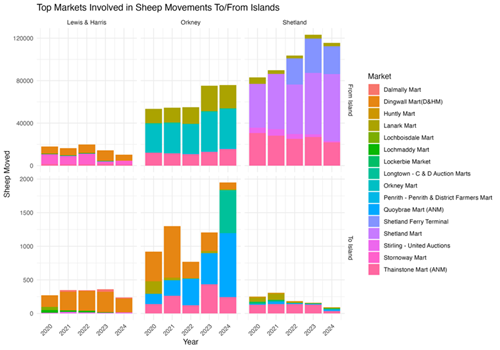
Figure 1. Annual sheep movements to (bottom panel) and from (top panel) the Scottish islands (Lewis & Harris,
Orkney, Shetland) by market and year (2020–2024). Top markets include Quoybrae, Thainstone, Dingwall, and
Orkney Mart, many of which serve multiple islands, creating shared trade links that are relevant for coordinated
biosecurity and sheep scab control.
