
Overview
- Where a Bluetongue Restriction Zone is in place, Bluetongue testing may be required for all live movements to areas outside of the zone.
- Routine livestock movements indicate that in 2024, of the total cattle and sheep moved cross-border into Scotland, 50,135 cattle (68% of total moves; remainder are to slaughter) and 193,696 sheep (82%) would be affected by Bluetongue testing requirements under an expansion of the Bluetongue Restriction Zone (RZ) to all of England.
- In 2024, approximately 38% of cross-border movements of cattle and 81% of cross-border sheep movements into Scotland involved a market stop. Under a testing scenario, this would have affected 28,087 cattle and 191,597 sheep moved from England to Scotland via markets.
- In 2024, applying prices based on species and likely production type, the estimated annual value of the animals moved cross-border into Scotland was £89.3-90.4 million for cattle, and between £19.4-37.9 million for sheep.
Using data from 2018-2024 on species, routes, and market involvement, these analyses identified the cross-border cattle and sheep movements that could be impacted by a restriction zone applied to all of England. Here, cross-border movements are defined as movements either into Scotland from England or movements in circular flows that return to Scotland; moves to live would be considered for testing whilst moves to slaughter would not. Analyses also estimated the economic value of the livestock moved cross-border to help policymakers better assess the overall impact to markets and livestock keepers.
Annual and monthly movement volumes were estimated for both cattle and sheep (Figure 1).
• In 2024, a total of 50,135 cattle and 193,696 sheep were moved cross border into Scotland to live and would have been affected by testing requirements under this scenario. These figures represent 68% of cattle and 82% of sheep cross-border movements (England to Scotland); the remainder are moves to slaughter.
• The number of cattle moved per month ranged from 2,500 in December to ~5,800 (May) and ~6,200 (October). The number of sheep moved per month ranged from approximately 8,300 in June to over 28,000 in September, consistent with seasonal trading patterns.
Livestock markets play a central role in cross-border movements, especially for sheep.
• When considering all recorded cross-border movements into Scotland in 2024, movements that included a market stop accounted for approximately 81% of sheep and 38% of cattle movements. Specifically considering the subset of movements that would be affected by pre/post movement testing (i.e. movements from England to Scotland to live, not to slaughter), 28,087 cattle and 191,597 sheep moved via markets, representing the majority of affected movements (Figure 2).
• Specific markets handle high volumes of trade and may be more impacted by control measures. Longtown Mart (Cumbria) is the highest-volume mart for sheep entering Scotland, while Harrison & Hetherington, Borderway Mart, and Carlisle consistently handle the most cattle moving from England and Wales to Scotland.
• Remaining cross-border movements are slaughter movements, which do not require testing. Show-related movements account for 0.6% of cattle cross-border moves and >0.002% for sheep.
Cattle moved cross border were valued at £89.3 - 90.4 million, sheep at £19.4-37.9 million.
• Using two methods, the value of cattle moved into Scotland to live was estimated. Through use of a standardised method and applying a weighted average store cattle price of £1,780.71 per head, the total annual value was estimated at approximately £89.3 million. A classification-based method, which applied more detailed pricing by movement type and animal characteristics, yielded a slightly higher estimate of £90.4 million.
• For sheep moved into Scotland to live, the estimated annual values using a breeding sheep valuation of £193.56 per head was £37.9 million. Using a store sheep valuation of £100 per head, the total was £19.4 million.
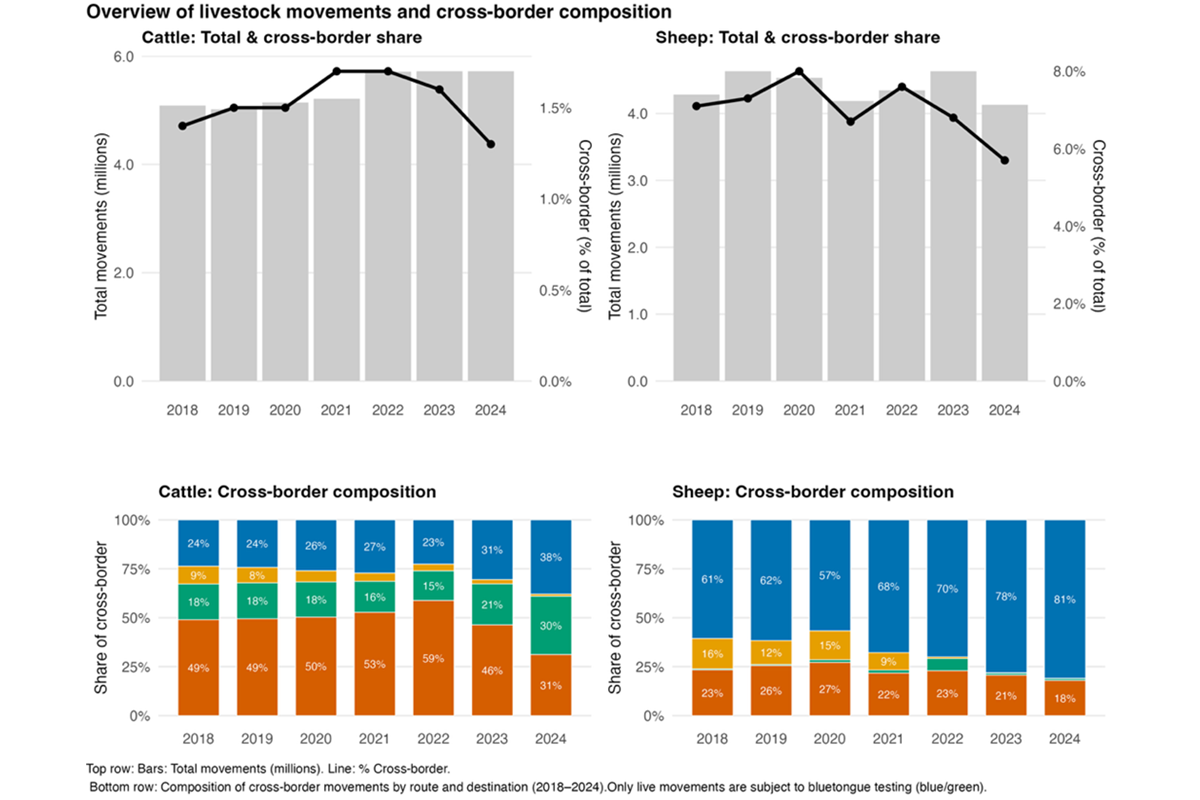
Figure 1. Top panels show total annual livestock movements (millions; grey bars, left axis) and the proportion of movements that are cross-border into Scotland (black line, right axis) for cattle (left) and sheep (right). Note that cross-border movements represent a small proportion of total movements, particularly for cattle. Bottom panels show the composition of cross-border movements by route and destination, including movements to live via markets (blue), direct to live (green), and movements direct to slaughter (orange) or via a market to slaughter (yellow). Only live cross-border movements (blue and green) would potentially be subject to testing.
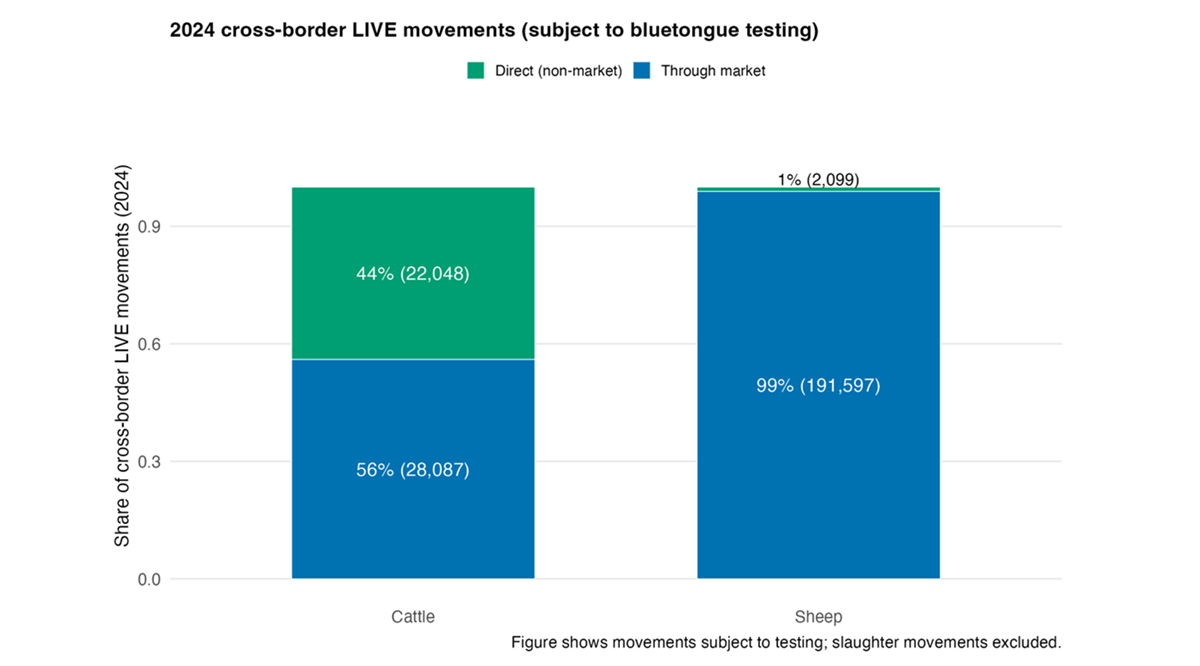
Figure 2. Proportion and number of cross-border live movements into Scotland (including circular movements returning to Scotland) by route: direct (non-market) and via markets. Slaughter movements are excluded. Sheep movements are overwhelmingly market-driven, whereas cattle movements are more evenly split between direct and market routes.
These findings were provided to Scottish Government in early July 2025 to support decisions on cross-border livestock movements in the case of a restriction zone being implemented for all of England in 2025. The findings can: (1) Inform the number of livestock that may be most affected by bluetongue testing in the event of a restriction zone for all of England. (2) Provide livestock valuation data based on species, route, and market involvement to consider potential cost implications of testing and economic effects on markets. This market data could be updated in future years to support ongoing policy refinement. (3) Provide a valuable baseline for planning future disease control strategies as seasonal movement patterns and market dependencies are expected to remain relevant for future vector-active seasons.
• Data sources and processing: (1) Cattle movement data recorded from 2018 to 2024 were extracted from two sources, the ScotEID repository on the EPIC server and the CTS database, and were harmonised and combined into a single dataset. (2) Scottish sheep movements were retrieved from ScotEID (batched and individual) while English/Welsh sheep movements were retrieved from AMLS (batched only), together with their respective locations data. (3) The data was cleaned by removing duplicated movements, consolidating journeys (e.g. via markets) which were spliced into separate movements, and flagging invalid records as ‘Unspecified’.
• Recording and data quality: (1) Despite the data cleaning measures, there was an increase in recorded movements within and out of Scotland after the introduction of the CattleEID system; it is unclear whether this reflects a true increase in movements or changes in recording practices. (2) Further investigation is needed to determine if the time-frame of movements parsed into one should be expanded, and whether additional movements on the same premises on different dates represent true movements or recording errors.
• Definition of cross-border movements: Cross-border movements are defined here as movements either into Scotland from England or movements in circular flows that return to Scotland.
• Valuation and classification assumptions: (1) Economic values are estimated using simplified pricing approaches. For cattle, both a standardised weighted average price and a classification-based method were applied, while for sheep, fixed average values were used. These approaches provide indicative estimates and do not capture full variation in prices by animal type, condition, timing, or market. (2) Classification of cattle into production categories (e.g. store, dairy replacement, calf, breeding) was inferred from available variables such as sex, age, breed group, and production type; misclassification is possible where data are incomplete or ambiguous.
• Potential bias in valuation estimates: (1) The classification-based valuation approach for cattle may overestimate values in some cases if animals are misclassified or if price assumptions are not fully representative, while the use of average or fixed prices may underestimate variability in market values. (2) Estimated economic values are subject to uncertainty arising from both price assumptions and classification methods; where applied, uncertainty ranges (e.g. ±10%) provide an approximate indication of this variability and should not be interpreted as precise confidence intervals.
• Temporal scope: The analysis is based on 2024 data as a representative year; movement patterns and economic values may differ under future policy, market, or disease conditions.
Featured:


Prof. Harriet Auty
Veterinary Epidemiologist,
School of Biodiversity, One Health and Veterinary Medicine, University of Glasgow